
Article Summary
A urinalysis is a high-level screening tool used to identify potential issues like infection, kidney stress, or diabetes. A single flagged result rarely confirms a condition on its own without considering your physical symptoms and clinical history.
- Mid-Stream Catch: Clinical data shows that using antiseptic wipes has a negligible effect on reducing contamination. To get the most accurate result, focus on capturing the "mid-stream" portion of your urine to flush away external bacteria and skin cells.
- Factors Affecting Results: Results like protein or specific gravity are highly sensitive to your daily activities. Factors such as intense exercise, your level of hydration, and even your recent diet can cause these numbers to fluctuate outside of the "normal" range.
- Recommended Guidelines: New clinical guidelines for 2025 recognize that trace amounts of blood in the urine for women under 60 are often low-risk. If you fall into this category, your doctor may recommend simple monitoring rather than immediate invasive procedures.
- Myths vs Truths: Cloudy urine or a strong odor are not definitive signs of a urinary tract infection. These changes are often caused by dehydration or diet and should only be a cause for concern if you are also experiencing pain or increased urgency.
- Sample Stability Matters: Because urine changes chemically once it leaves the body, samples must be analyzed within one to two hours. If you are collecting at home, remember to refrigerate the sample at 4 degrees Celsius to keep the results reliable for the lab.
That moment when you log into your patient portal and see a flagged urinalysis lab result? Your stomach drops. However, a single abnormal number rarely tells the whole story. At LabTestGuru.com, our goal is to translate dense clinical reports into clear, actionable health information.
Today we are talking about the urinalysis, a test you have likely taken dozens of times, and one that women in their thirties, forties, and fifties often misread because the numbers look alarming without the right context behind them.
Why Your Urinalysis Result Isn't Always a Diagnosis
A urinalysis is a first-line, low-cost screening test that helps clinicians look for urinary tract infections, kidney disease, diabetes-related changes, liver or bile issues, and blood in the urine (1). The clinical usefulness of urinalysis depends entirely on reading the results alongside your symptoms. A flagged urinalysis result is a decision aid. It is not a definitive standalone diagnosis.
Many abnormal urinalysis findings require no immediate invasive intervention at all. Major clinical guidelines actually recommend against routine urinalysis screening for asymptomatic bacteriuria in nonpregnant women, because treatment typically provides no benefit and can contribute to unnecessary antibiotic resistance (2). What a urinalysis result actually means depends heavily on your physical symptoms, contamination risks during collection, pregnancy status, and exactly what the lab measured.
The "Clean Catch" Debate: Do You Really Need the Wipes?
If you have ever been handed a plastic cup and a packaged antiseptic wipe at the clinic, you know the "clean catch" routine well. The goal is to minimize vaginal or menstrual contamination. But here is something that might surprise you: recent clinical data suggests that cleansing the genital area beforehand carries no proven benefit for reducing contamination. One study found similar contamination rates of 32 percent for women who cleansed versus 29 percent for those who did not cleanse at all (3).
What matters far more than the antiseptic wipe is catching the urinalysis sample mid-stream. The initial flow of urine flushes surface bacteria away from the urethra, so collecting the middle portion gives the lab a much more accurate sample to work with. Clear urinalysis collection instructions are what improve results, reduce contamination, and cut down on repeat samples.
Decoding the Dipstick: From pH to Protein
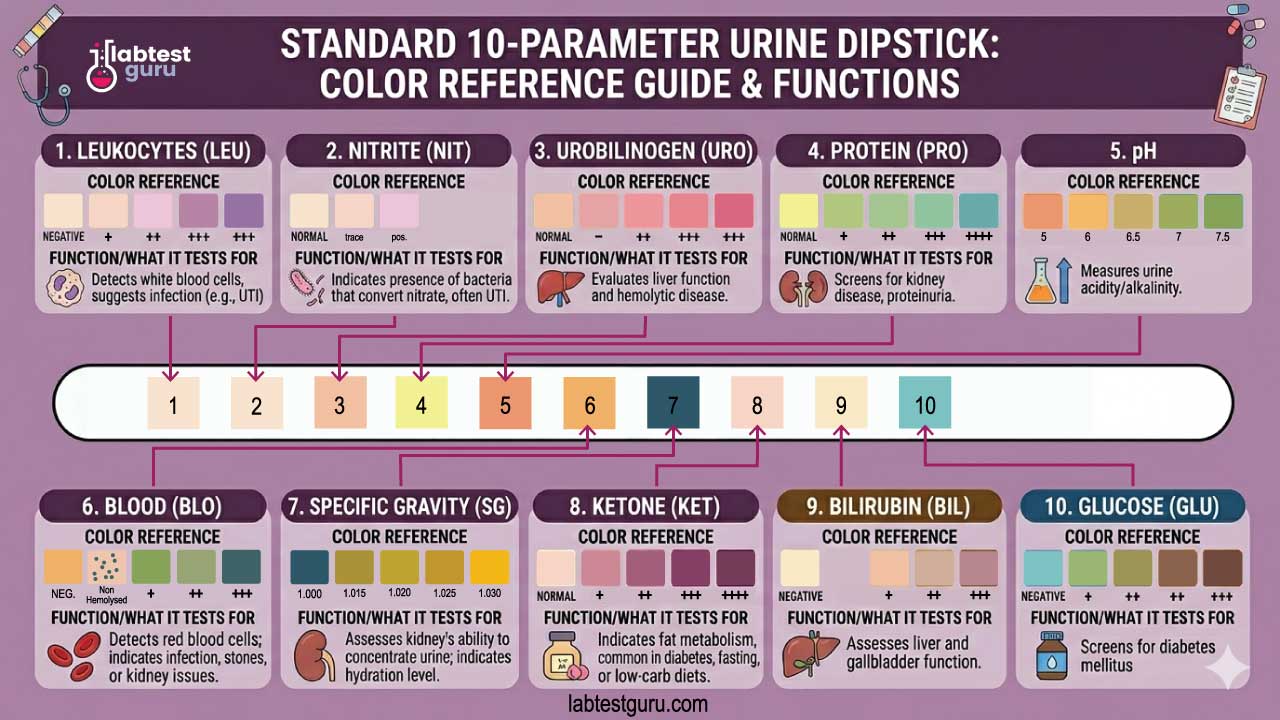
The chemical examination of your urinalysis sample is usually performed with a rapid dipstick test. This small strip contains chemical pads that change color based on what is in your urine. Here is what the key clinical markers actually tell us.
Why Context Matters (Symptoms vs. Numbers)
Two common urinalysismmarkers pathologists look at are specific gravity and protein. Normal urinary specific gravity typically runs from 1.002 to 1.035, with 1.016 to 1.022 being the standard for healthy concentration (4). A number outside that range often means nothing more alarming than dehydration or drinking too much water before the test.
For protein, normal excretion is 150 mg per day or less (5). Findings above 300 mg per gram of creatinine are classified as severely increased, but your doctor will look at other factors like blood pressure before drawing any conclusions. On the infection side, positive nitrites are highly specific for a UTI, carrying a likelihood ratio of 13. At the other end, negative results for leukocyte esterase, nitrites, and blood together carry a strong negative likelihood ratio of 0.1, which makes them excellent for ruling out an active infection (6).
False Positives: Menstruation, Exercise, and Diet
Women aged 30 to 50 run into false positives on urinalysis lab reports more often than most people realize. A heavy cardio session the day before your urinalysis test can temporarily push protein levels up. Your menstrual cycle can introduce stray red blood cells into the sample cup, triggering a positive result for hematuria, which simply means blood in the urine. Even what you ate recently plays a role. Blackberries and beets can alter the color of your urine entirely. Mild dehydration can concentrate the urinalysis sample so much that trace elements read as alarmingly high.
Here is a quick urinalysis reference guide to standard result thresholds:
- Specific Gravity: 1.002 to 1.035 is normal. Abnormalities usually point to hydration status.
- Protein: Normal is negative or under 150 mg per day. Elevated levels can indicate temporary physical stress or potential kidney strain.
- Nitrites: Normal is negative. A positive result indicates a high likelihood of a bacterial infection.
Standard 10-Parameter Urine Dipstick Color Reference Guide
| Parameter | Normal / Negative Color | Positive / Abnormal Color Range | What it Usually Means |
| Leukocytes | Off-white / Cream | Pink to Dark Purple | Presence of white blood cells (potential infection). |
| Nitrite | White / Off-white | Light Pink to Bright Pink | Often indicates bacteria that convert nitrate to nitrite (UTI). |
| Urobilinogen | Light Pink / Yellow | Dark Pink to Red | High levels can suggest liver disease or red blood cell breakdown. |
| Protein | Yellow / Green-Yellow | Green to Dark Blue-Green | May indicate kidney stress, intense exercise, or infection. |
| pH | Orange / Yellow (approx. 5.0) | Green to Blue (up to 8.5+) | Measures acidity; helps identify stone risk or metabolic issues. |
| Blood | Orange / Yellow | Speckled Green to Solid Dark Blue | Indicates red blood cells, hemoglobin, or myoglobin. |
| Specific Gravity | Blue-Green (1.000) | Green to Yellow (1.030+) | Measures concentration; indicates hydration levels. |
| Ketones | Buff / Light Pink | Pink to Deep Maroon / Purple | Indicates the body is burning fat for fuel instead of glucose. |
| Bilirubin | Off-white / Cream | Pinkish-Tan to Brown | Often a marker for liver or gallbladder issues. |
| Glucose | Blue / Teal | Green to Dark Brown | Suggests high blood sugar levels (common in diabetes). |
Notes:
- Timing is everything: Most urinalysis pads must be read at exactly 60 seconds, though Leukocytes can take up to 120 seconds to fully develop. Reading too early or too late can give you a false result.
- Interference: High doses of Vitamin C (ascorbic acid) can sometimes "bleach" the pads for blood or glucose, leading to a false negative.
- The "Visual Exam": Remember that the physical color of the urine itself (the liquid in the cup) can sometimes mask the colors on the stick, especially if the urine is very dark or bloody.
When Blood in Your Urinalysis Isn't an Emergency
Seeing a blood flag on your lab report can be genuinely frightening. Historically, microscopic hematuria often triggered immediate referrals for invasive procedures like cystoscopy. Urology guidelines have evolved significantly, though. New 2025 guidance emphasizes strategic risk-stratification, and women under 60 without other risk factors are now often classified as low-risk for microscopic hematuria (7).
Rather than moving straight to advanced imaging, your healthcare provider may choose to repeat the test in a few months. This is a major clinical shift that is sparing countless women from unnecessary anxiety and invasive testing protocols.
Myths vs. Realities: Odor, Color, and Cloudiness
There is a persistent myth that cloudy or strong-smelling urine automatically means you have an infection. It does not. Changes in appearance or odor alone should not be used to diagnose a UTI or as a reason to order a urine culture (8).
Mild dehydration, foods like asparagus, and completely harmless vaginal discharge can all change how your sample looks and smells. Do not panic over visual changes unless they come alongside physical symptoms like pelvic pain, burning during urination, or a noticeably increased urge to void.
When to Ask for a Culture or Follow-Up
A dipstick test is an excellent first screening tool, but it has real limitations. If you have persistent urinary symptoms but a completely negative dipstick result, or if protein or blood keeps showing up over several months, a formal urine culture or specialized follow-up testing becomes the clinical reference standard.
Navigating the Practical Hurdles
Sample stability is one factor many patients never think about. Urine begins changing its chemical composition almost immediately after collection. Samples must be tested within one to two hours or refrigerated at 4 degrees Celsius for no more than 24 hours to stay reliable (9).
If you have a shy bladder at the clinic or you are currently on your period, say something to your nurse. Rescheduling collection by a few days is often a smarter call than submitting a contaminated sample that produces a confusing report.
And if you collected a sample at home and left it sitting on the bathroom counter all day without refrigerating it, start fresh. Bacteria multiply rapidly at room temperature, and no pathologist can produce accurate results from a sample that has been sitting out that long.
Frequently Asked Questions (FAQs)
Can I perform a urinalysis while I am on my period?
Yes, you can still provide a urinalysis sample during your menstrual cycle, but you must inform your healthcare provider. Menstrual blood frequently causes a false positive for red blood cells on the dipstick. Knowing you are on your period allows the pathologist to correctly attribute these cells to your cycle rather than potential kidney issues or urinary tract concerns (7).
Does drinking too much water before the test affect my results?
Excessive hydration can dilute your urine, which may mask certain markers like protein or glucose. It specifically impacts your specific gravity reading, which typically ranges from 1.002 to 1.035 (4). If your urine is too dilute, the lab might request a repeat sample from your first morning void, which is naturally more concentrated and provides a clearer clinical picture.
Why is the "mid-stream" collection so important?
The first few seconds of your urine stream often contain bacteria or skin cells from the external area. By letting the initial burst go into the toilet and catching the middle portion, you ensure the lab is testing the fluid that was actually inside your bladder. This significantly reduces the 29 to 32 percent contamination rate commonly seen in female samples (3).
Can my daily vitamins or supplements change the color of the results?
Absolutely. High doses of Vitamin C, or ascorbic acid, are notorious for interfering with chemical dipstick reactions. Vitamin C can "bleach" the pads for glucose and blood, potentially causing a false negative result even if those substances are present. Additionally, B-complex vitamins can turn urine a bright, neon yellow, while some medications can turn it orange or blue-green.
What should I do if I cannot get my sample to the clinic right away?
Urine is a biologically active fluid that changes composition the moment it leaves your body. If you are collecting a sample at home, you must deliver it to the lab within one to two hours. If that is not possible, you must refrigerate the sample at 4 degrees Celsius for no more than 24 hours (9). Leaving a sample at room temperature allows bacteria to multiply rapidly, which will lead to inaccurate results.
Disclaimer: This information is for general knowledge and informational purposes only and does not constitute medical advice. Always consult with a qualified healthcare professional for any health concerns or before making any decisions related to your health.
References
- https://www.aafp.org/pubs/afp/issues/2022/0700/office-based-urinalysis.html
- https://www.uspreventiveservicestaskforce.org/uspstf/recommendation/asymptomatic-bacteriuria-in-adults-screening
- Glogowska, M., Croxson, C., & Hayward, G. (2022). Women's information needs around urine testing for urinary tract infections: a qualitative study. The British journal of general practice : the journal of the Royal College of General Practitioners, 72(717), e244–e251. https://doi.org/10.3399/BJGP.2021.0564
- Queremel Milani DA, Jialal I. Urinalysis. [Updated 2023 May 1]. In: StatPearls [Internet]. Treasure Island (FL): StatPearls Publishing; 2026 Jan-. Available from: https://www.ncbi.nlm.nih.gov/books/NBK557685/
- https://www.vinmec.com/eng/blog/instructions-for-reading-normal-urine-test-results-en
- Hitzeman N, Greer D MD, MPH, Carpio E. Office-Based Urinalysis: A Comprehensive Review. Am Fam Physician. 2022 Jul;106(1):27-35B. PMID: 35839369.
- Hafron, Jason M. “2025 AUA SUFU Microhematuria Guideline.” Grand Rounds in Urology. Published July 10, 2025. Accessed Apr 2026. https://grandroundsinurology.com/2025-aua-sufu-microhematuria-guideline/
- https://ammi.ca/wp-content/uploads/2021/09/AC-UTI-Myths-and-Truths-1-pager_Eng_rev1FINAL.pdf
- https://www.mayoclinic.org/tests-procedures/urinalysis/about/pac-20384907