
Key Takeaways
Prediabetes is a reversible metabolic state affecting 1 in 3 American adults, yet 90% of those affected are completely unaware of their condition.
- The Mechanism: It is driven by insulin resistance, where cells fail to respond properly to insulin, causing sugar to build up in the bloodstream instead of being used for energy.
- Key Risk Factors: For women in their thirties and forties, a history of gestational diabetes is a major biological warning sign. Additional risks include strong family history and sedentary behavior.
- Visible Clues: While largely asymptomatic, darkened, velvety skin patches (acanthosis nigricans) in body folds can physically manifest high insulin levels.
- Diagnostic Benchmarks: Prediabetes is diagnosed when Fasting Plasma Glucose is between 100 and 125 mg/dL, or when Hemoglobin A1C falls between 5.7% and 6.4%.
- The Reversal Strategy: Progression to type 2 diabetes is not inevitable. A 58% risk reduction is possible through structured lifestyle changes.
What is Prediabetes and Why Does It Matter?
Prediabetes is a critical, reversible metabolic state that sits one step before type 2 diabetes. Right now, approximately 1 in 3 American adults, about 84 million people, have this condition (Centers for Disease Control and Prevention). What should concern us most is that clinically, about 90% of those people have no idea. Without intervention, up to 70% of them will eventually receive a full type 2 diabetes diagnosis (Alvarez et al., 2023).
The Science of Resistance: How Insulin Stops Working Properly
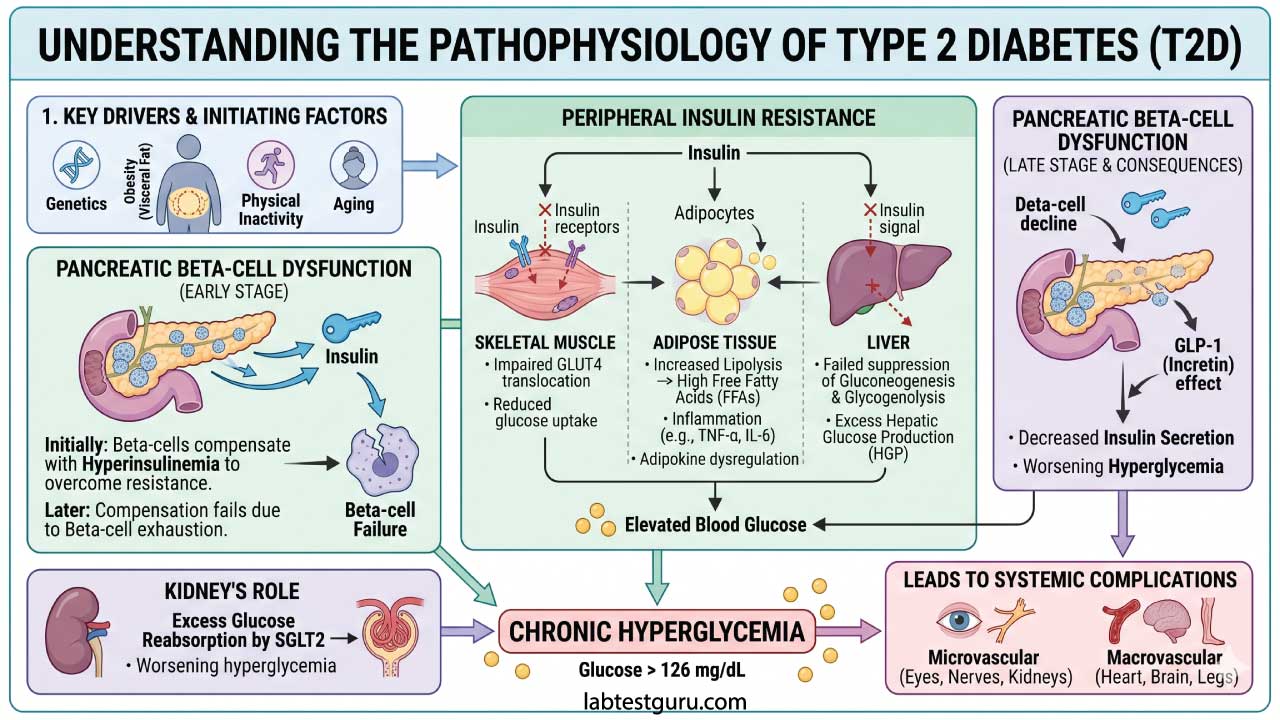
To understand what is happening in our body, we need to look at how our cells process energy. We eat. Our digestive system breaks food down into glucose. Our pancreas releases insulin, a hormone that acts like a key, opening our cells so they can absorb that glucose. In type 2 diabetes and its precursor states, our body stops using insulin properly. This is what we call insulin resistance (Alvarez et al., 2023). Because our cells resist the insulin, sugar accumulates in our bloodstream instead of fueling our body. Over time, that chronic high blood sugar causes systemic damage to the heart, kidneys, and nerves (Alvarez et al., 2023).
Are You at Risk? Identifying the Genetic and Lifestyle Factors
Many women assume that feeling fine means their blood sugar is fine. It does not. Specific risk factors significantly raise your chances of developing insulin resistance, and some of them are already written into your history. A history of gestational diabetes is a major red flag. Pregnancy places an immense metabolic load on the body. If your pancreas struggled to keep pace during those nine months, that is a clear biological signal to act now. Genetics also carry real weight. Your lifetime risk of developing type 2 diabetes reaches 40% if one biological parent has it, and climbs to 70% if both parents do (Cleveland Clinic, 2025). Sedentary behavior adds to that load. Sitting for long periods is an independent risk factor on its own, which is why you should aim to get up and move every 30 minutes (Mayo Clinic, 2025).
Acanthosis Nigricans: The Visible Skin Sign
Most metabolic changes are invisible. But occasionally, your skin tells the story first. Acanthosis nigricans appear as darkened, velvety patches in body folds like the neck or armpits. This dermatological change is a direct physical sign of high insulin levels circulating in the blood, and it warrants immediate lab testing (Mayo Clinic, 2025).
Diagnostic Tests and What They Mean
You should never walk out of a clinic confused by a number on a page. When you understand exactly what your diagnostic markers mean, you gain the power to change them.
A1C vs. Fasting Glucose
Two primary blood tests evaluate your metabolic health. The Fasting Plasma Glucose test measures the sugar in your blood after at least eight hours without eating. Below 100 mg/dL is normal. A level from 100 to 125 mg/dL indicates prediabetes. At 126 mg/dL or higher, the result points to diabetes (MedlinePlus, 2025).
The Hemoglobin A1C test gives you the longer view. It measures the percentage of your red blood cells carrying sugar-coated hemoglobin over the past two to three months. Below 5.7% is normal. Between 5.7% and 6.4% falls into the prediabetic range. At 6.5% or higher, the result indicates diabetes (MedlinePlus, 2025). Tracking these specific numbers lets you see, in concrete terms, exactly how your lifestyle changes are working.
The 3 Pillars of Lifestyle Change
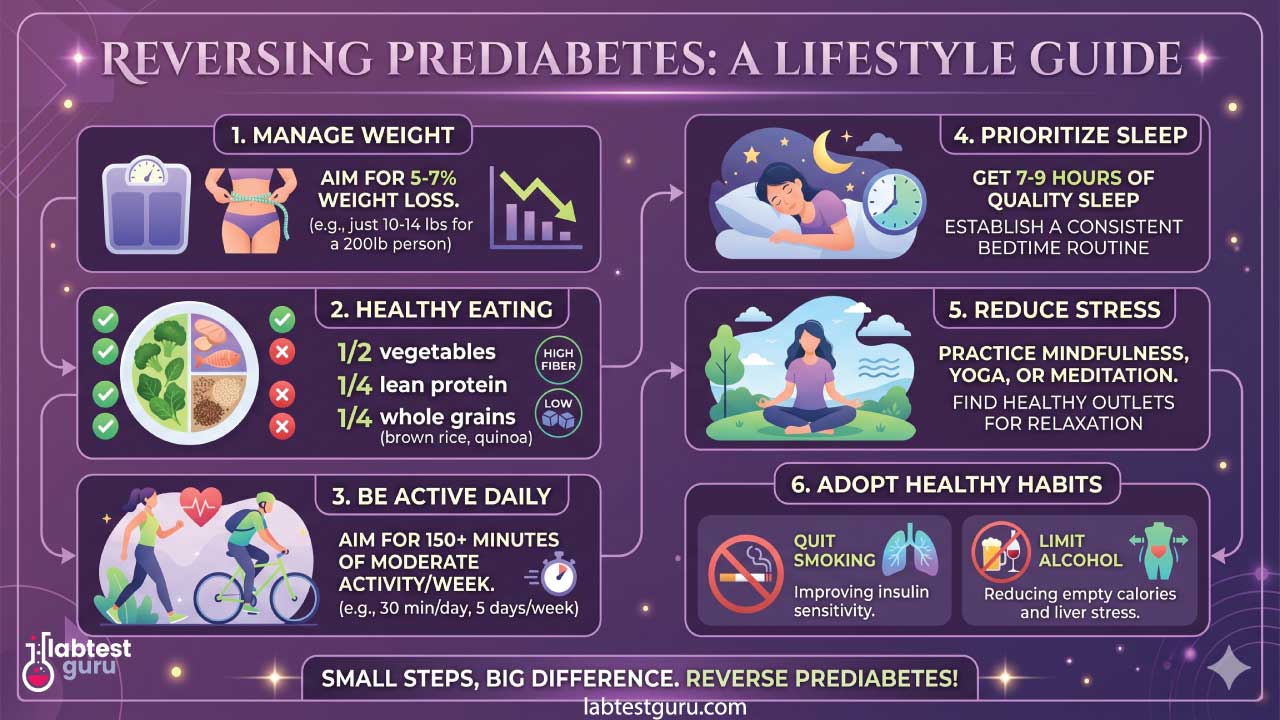
Here is the most important thing I want you to hear: this is not a life sentence. Prediabetes is reversible through significant lifestyle changes (Alvarez et al., 2023). Joining a structured lifestyle change program can lower your risk of progressing to type 2 diabetes by 58% (Centers for Disease Control and Prevention).
The "5% Rule" for Weight Loss
You do not need to reach some idealized body weight to see real metabolic benefits. Healthy bodies come in different shapes and sizes, and losing weight through drastic means can be both dangerous and counterproductive (Mayo Clinic, 2025). What the evidence actually supports is the 5% rule. Losing just 5% to 7% of your body weight, roughly 10 to 14 pounds for a 200-pound person, significantly reduces the risk of disease progression (Centers for Disease Control and Prevention).
The Movement Benchmark
Physical activity is the second pillar of reversal for prediabetes. Aim for at least 150 minutes per week of moderate-intensity activity, like brisk walking. That is the primary recommendation for prevention and management (Centers for Disease Control and Prevention). Think of exercise as a back door for glucose to enter your muscle cells, bypassing the need for insulin entirely and directly bringing your blood sugar down.
Building an Interprofessional Care Team
Managing your health in combating prediabetes should not be a solo effort. A care team that includes your primary physician, a registered dietitian, and a certified diabetes care and education specialist gives you comprehensive, evidence-based support from every angle (Alvarez et al., 2023).
Managing Stress and Mental Health
The connection between your mind and your metabolism is real, biological, and frequently overlooked. People dealing with metabolic conditions face a significantly higher risk of depression or anxiety (Cleveland Clinic, 2025). Chronic stress elevates cortisol, which raises blood sugar and worsens insulin resistance. Addressing your mental health through therapy, mindfulness, or support groups is not secondary care. It is part of the same treatment plan as your diet and your exercise routine.
Preventing the Shift to Type 2 Diabetes
About 90% to 95% of the more than 40 million Americans living with diabetes have type 2 (Centers for Disease Control and Prevention). The economic cost reaches approximately $245 billion annually in the United States (Alvarez et al., 2023). More personally, the daily toll on quality of life can be immense. But you are not on a fixed path toward that outcome. By tracking your lab results, making steady lifestyle adjustments, and building the right support around you, you can reverse this metabolic trend before it goes any further.
Frequently Asked Questions (FAQs)
Can I actually reverse prediabetes, or is type 2 diabetes inevitable?
It is absolutely reversible. A prediabetes diagnosis is a warning, not a life sentence. By adopting significant lifestyle changes, such as modifying your diet and increasing your physical activity, you can lower your risk of progressing to type 2 diabetes by up to 58%.
How do I know if I have prediabetes if I feel perfectly fine?
Prediabetes is notoriously silent, and most people experience zero symptoms. The only definitive way to know your status is to have your healthcare provider check your blood using a Fasting Plasma Glucose or an A1C test.
Does having gestational diabetes mean I will definitely get type 2 diabetes later?
Not necessarily, but it is a significant biological red flag. Pregnancy places a heavy metabolic load on your body. If your pancreas struggled to keep up then, your risk for insulin resistance is naturally higher now. This makes proactive screening and lifestyle management essential.
Do I need to lose a massive amount of weight to fix my blood sugar?
No. Drastic weight loss is unnecessary and can sometimes be dangerous. Clinical guidelines recommend the "5% rule." Losing just 5% to 7% of your total body weight (about 10 to 14 pounds for a 200-pound person) is enough to significantly improve your cellular response to insulin.
What is the best type of exercise to lower my blood sugar?
The goal is to achieve at least 150 minutes of moderate-intensity movement per week. Brisk walking is highly effective. Exercise allows glucose to enter your muscle cells without needing insulin, directly lowering the sugar levels in your bloodstream.
How does stress affect my blood sugar levels?
The mind and metabolism are deeply connected. Chronic stress causes your body to release cortisol. High cortisol levels naturally raise your blood sugar and worsen insulin resistance. Addressing your mental health is just as important as changing your diet.
References
- https://www.cdc.gov/diabetes/prevention-type-2/prediabetes-prevent-type-2.html?CDC_AAref_Val=https://www.cdc.gov/diabetes/basics/prediabetes.html (Accessed on April 26th, 2026).
- Alvarez S, Coffey R, Mathias PM, et al. Prediabetes. [Updated 2023 Jul 17]. In: StatPearls [Internet]. Treasure Island (FL): StatPearls Publishing; 2026 Jan-. Available from: https://www.ncbi.nlm.nih.gov/books/NBK459332/
- https://my.clevelandclinic.org/health/diseases/21501-type-2-diabetes (Accessed on April 26th, 2026)
- https://www.mayoclinic.org/diseases-conditions/type-2-diabetes/symptoms-causes/syc-20351193 (Accessed on April 26th, 2026)
- https://medlineplus.gov/prediabetes.html (Accessed on April 26th, 2026)
- https://www.cdc.gov/diabetes/about/about-type-2-diabetes.html (Accessed on April 26th, 2026)