
A CBC with differential is a standard blood panel that measures red blood cells, white blood cells, and platelets. CBC with differential is commonly part of your annual blood test. But interpreting this test is not a one-size-fits-all process. Targeted bloodwork means looking at your results through the specific lens of your age, sex, and life stage.
Women in their 30s, 40s, and early 50s are going through real biological shifts. Perimenopausal hormonal changes, heavy menstrual cycles, and fluctuating iron stores all affect your numbers. Medical research shows that women in the 18 to 45 age bracket have measurably different red blood cell, white blood cell, and platelet reference intervals compared to older women and men (1).
What the CBC with Differential Tells Your Doctor
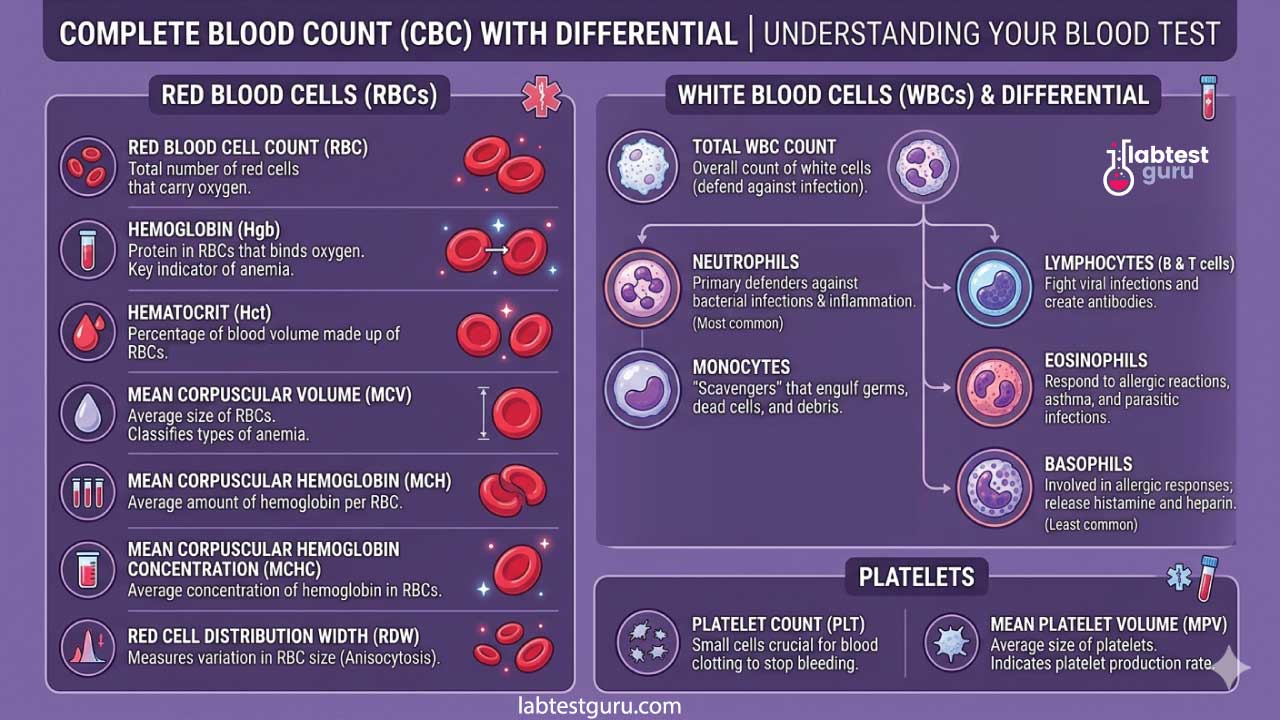
A standard Complete Blood Count or CBC with differential gives your doctor a broad overview of your blood cells. The differential breaks your white blood cells down into five distinct types. That breakdown works as a targeted screening tool, helping your clinical team pinpoint exactly what kind of stress your body is under. Whether it is a bacterial infection, a viral illness, an allergic reaction, or a parasitic issue, the differential gives them a much clearer starting point.
Red Blood Cell (RBC) Parameters: The Oxygen Delivery Team
These parameters focus on how your body transports oxygen from your lungs to your tissues and carries carbon dioxide back.
- RBC Count: The total number of red blood cells in a microliter of blood. Its primary function is to serve as the "shipping fleet" for oxygen.
- Hemoglobin (Hgb): The iron-rich protein inside the RBC that actually "grabs" the oxygen. Without enough Hgb, even a high RBC count won't effectively oxygenate the body.
- Hematocrit (Hct): This measures the "crowdedness" of your blood. It is the percentage of total blood volume made up of red cells. If this is too low, you’re anemic; if it's too high, the blood can become too thick to flow easily.
- RBC Indices:
- MCV (Mean Corpuscular Volume): Measures the average size of your RBCs. This helps distinguish between different types of anemia (e.g., small cells often suggest iron deficiency).
- MCH (Mean Corpuscular Hemoglobin): The average weight of hemoglobin per cell.
- MCHC (Mean Corpuscular Hemoglobin Concentration): The density of hemoglobin in a given volume of RBCs. Essentially, how "saturated" the cell is with its oxygen-carrying protein.
- RDW (Red Cell Distribution Width): This measures the variation in size between your RBCs. A high RDW means you have a mix of very large and very small cells, which often signals that the bone marrow is struggling to produce uniform cells.
White Blood Cell (WBC) Differential: The Immune Defense
The "Differential" breaks down the total WBC count into five specific types of "soldiers," each with a different specialty.
- Total WBC Count: The overall alarm system. A high count usually suggests the body is fighting something, while a low count might mean the immune system is exhausted or suppressed.
- Neutrophils: They are the first responders to the site of an infection, primarily focusing on killing bacteria and managing acute inflammation.
- Lymphocytes: These include B-cells (which make antibodies) and T-cells. They are the primary defenders against viruses and handle the body's long-term "memory" of past infections.
- Monocytes: These cells migrate into tissues to become macrophages, where they "eat" (phagocytize) dead cells, debris, and stubborn pathogens.
- Eosinophils: Their main job is to target multicellular parasites and manage the body’s response to allergens and asthma.
- Basophils: These are the rarest WBCs. They release histamine and heparin to trigger inflammation and blood flow to an area of concern, typically during an allergic reaction.
Platelet Parameters: The Repair Crew
Platelets (thrombocytes) are the smallest components of the blood, but they are vital for survival.
- Platelet Count: This counts the number of "band-aids" available in your blood. Their function is to rush to the site of a blood vessel injury, clump together, and form a plug to stop bleeding.
- MPV (Mean Platelet Volume): This measures the average size of your platelets. Generally, newer platelets are larger. A high MPV can indicate that the bone marrow is rapidly producing new platelets to replace ones that are being used up or lost.
CBC with Differential Reference Ranges (Adult Women)
| Parameter | Typical Reference Range | What It Measures |
| Red Blood Cells (RBC) | 4.0 – 5.2 million/µL | Total number of oxygen-carrying cells. |
| Hemoglobin (Hgb) | 12.0 – 16.0 g/dL | The protein that carries oxygen. |
| Hematocrit (Hct) | 36% – 46% | Percentage of whole blood made of red cells. |
| MCV | 80 – 100 fL | The average size of your red blood cells. |
| MCH | 27 – 33 pg | The average amount of hemoglobin in each cell. |
| MCHC | 32 – 36 g/dL | The concentration of hemoglobin in a volume of cells. |
| RDW | 11.5% – 14.5% | Variation in the size of red blood cells. |
| White Blood Cells (WBC) | 4,500 – 11,000/µL | Total count of immune system cells. |
| Neutrophils | 40% – 60% | Primary defenders against bacteria. |
| Lymphocytes | 20% – 40% | Primary defenders against viruses. |
| Monocytes | 2% – 8% | "Cleanup crew" for debris and chronic infection. |
| Eosinophils | 1% – 4% | Responders to allergies and parasites. |
| Basophils | 0.5% – 1% | Involved in inflammatory and allergic responses. |
| Platelets | 150,000 – 400,000/µL | Cells responsible for blood clotting. |
Myths vs. Reality: What Your CBC Results Actually Mean
There are a few stubborn misconceptions about this test worth clearing up. Many people assume a complete blood count checks every aspect of their health. It is a powerful tool, but it has real diagnostic limits. One of the most common questions I hear is, "Does CBC show kidney function?" The short answer is no. A CBC only looks at blood cells. To evaluate kidney or liver function, your doctor would need to order a completely separate test called a Comprehensive Metabolic Panel. A CBC with differential also cannot definitively rule out hormonal, metabolic, or cardiovascular issues, and it is not a primary screening test for solid tumors.
When "Abnormal" is Actually Normal: Benign Deviations
One result outside the standard range does not automatically mean something is wrong. Benign deviations are incredibly common. Mild shifts can come from dehydration, a recent workout, a passing cold, or simply where you are in your menstrual cycle. Your CBC should always be read in the context of your full clinical picture, not as a string of isolated numbers.
Emerging Trends: Personalized Reference Ranges and Well-Woman Panels
The medical community is moving away from generic reference intervals. There is a strong trend toward personalized reference ranges that account for age, sex, and even race. Many modern well-woman panels now automatically bundle the CBC with differential alongside iron studies and thyroid tests. That holistic view gives a much richer, more complete picture of female health across the mid-life decades.
Preparing for Your Test: Fasting, Medications, and Timing
Getting ready for your blood draw is usually straightforward. A basic CBC with differential does not require fasting. If your doctor orders it alongside a lipid panel or fasting glucose test, you will need to stop eating for 8 to 12 hours beforehand. Take your regular medications unless your doctor tells you otherwise, and drink plenty of water beforehand to keep your veins hydrated and the draw quick.
As for when to follow up on your CBC with differential results, a good rule of thumb is to wait for your doctor's office to reach out or send an interpretation through your patient portal. That said, if you are experiencing severe symptoms before your appointment, such as extreme fatigue, unexplained bruising, or a persistent fever, contact your healthcare provider right away.
Frequently Asked Questions (FAQs)
Does this test require fasting?
For a standalone CBC with differential, fasting is typically not required. However, if your bloodwork is part of a larger well-woman panel that includes a lipid profile or glucose test, you will likely need to fast for 8 to 12 hours. Always clarify with your provider’s office before your appointment.
Can a CBC with differential detect cancer?
CBC with differential can identify abnormal levels of white blood cells that might suggest blood-related cancers like leukemia or lymphoma. However, it is not a screening tool for solid tumors such as breast, lung, or ovarian cancer. CBC with differential is a screening test. It is not definitive for any disease or disorders.
Why are my white blood cell levels different from my partner's?
Research highlights that women in their 30s and 40s often have different reference intervals for white blood cells and platelets compared to men (1). These differences are normal and are accounted for by clinical laboratories using sex-specific standards.
When should I call my doctor about my results?
You should contact your healthcare provider if you see significant deviations in your results or if you are experiencing symptoms like extreme fatigue, unexplained bruising, or persistent fever. Your doctor will review the CBC with differential in the context of your symptoms and medical history.
Disclaimer: This information is for general knowledge and informational purposes only and does not constitute medical advice. Always consult with a qualified healthcare professional for any health concerns or before making any decisions related to your health.
References
- Nah, E. H., Kim, S., Cho, S., & Cho, H. I. (2018). Complete Blood Count Reference Intervals and Patterns of Changes Across Pediatric, Adult, and Geriatric Ages in Korea. Annals of laboratory medicine, 38(6), 503–511. https://doi.org/10.3343/alm.2018.38.6.503
- Goodarzi, E., Beiranvand, R., Naemi, H., Darvishi, I., & Khazaei, Z. (2020). Prevalence of iron deficiency anemia in Asian female population and human development index (HDI): an ecological study. Obstetrics & gynecology science, 63(4), 497–505. https://doi.org/10.5468/ogs.19196
- https://myhematology.com/white-blood-cells/white-blood-cells-wbcs-the-defenders-of-the-body/
- https://my.clevelandclinic.org/health/diagnostics/4053-complete-blood-count
- https://www.mayoclinic.org/tests-procedures/complete-blood-count/about/pac-20384919
- https://medlineplus.gov/lab-tests/complete-blood-count-cbc/
- El Brihi J, Pathak S. Normal and Abnormal Complete Blood Count With Differential. [Updated 2024 Jun 8]. In: StatPearls [Internet]. Treasure Island (FL): StatPearls Publishing; 2026 Jan-. Available from: https://www.ncbi.nlm.nih.gov/books/NBK604207/
- Tefferi A, Hanson C, Inwards D. How to Interpret and Pursue an Abnormal Complete Blood Cell Count in Adults Mayo Clinic Proceedings, 80, 923-936.